Araucaria heterophylla (Salisb.) Franco
Common Name
Norfolk Island pine
Family
Araucariaceae
Origin & Distribution
Native to Norfolk Island, located between Australia, New Zealand, and New Caledonia. Widely planted as an ornamental in tropical and subtropical regions around the world, including Nigeria, for landscaping, ceremonial plantings, and botanical collections.
Conservation Status
Vulnerable

Description
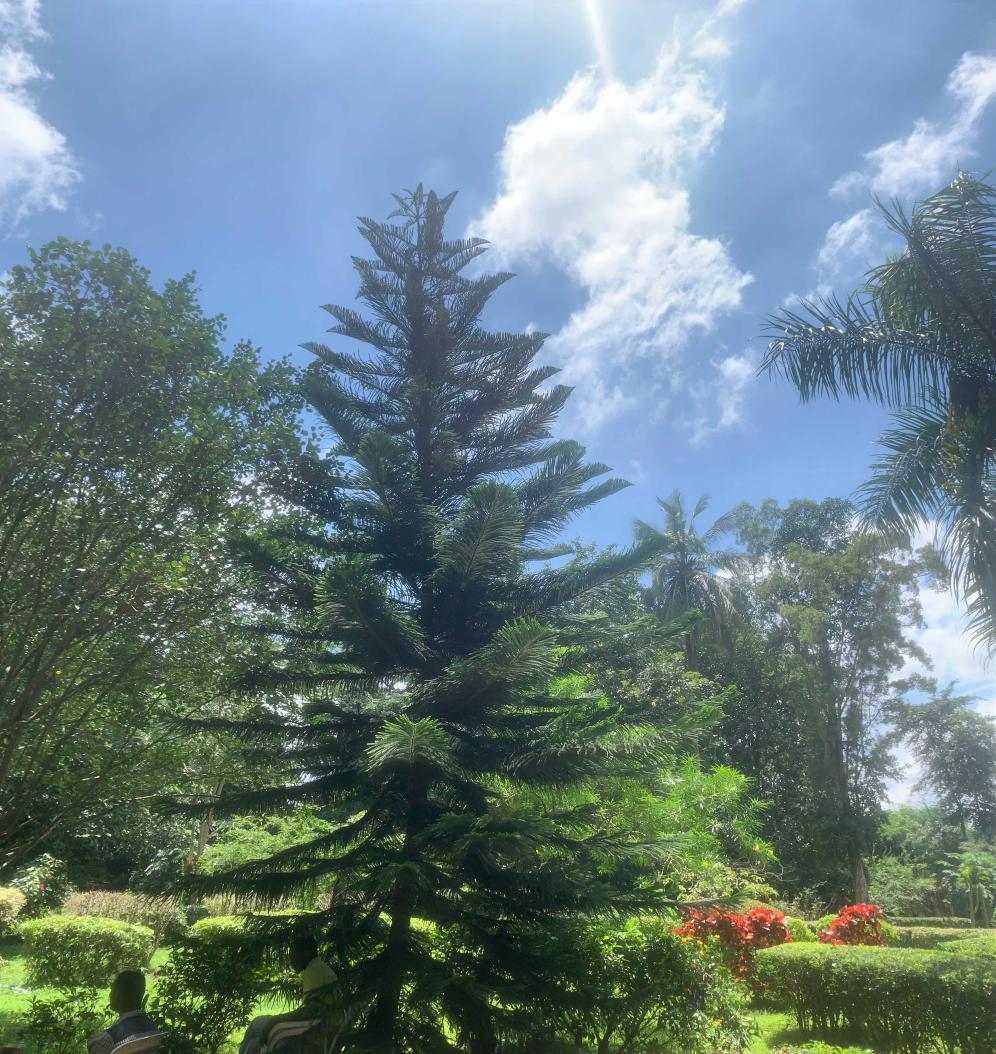
Evergreen conifer, slow-growing but can reach 50–65 m in its natural habitat; in cultivation in Nigeria, typically grows 15–25 m. Crown: Symmetrical and conical in young trees, becoming more irregular with age. Bark: Grey-brown, rough, with horizontal ridges. Leaves: Two types – juvenile leaves are soft, awl-shaped, and bright green; adult leaves are scale-like, triangular, and closely overlapping, giving the branches a feathery appearance. Branching: Whorled, with branches radiating horizontally in tiers, creating a distinctive layered look. Flowers: Gymnosperm – produces male and female cones on the same tree (monoecious). Cones: Male cones are cylindrical and smaller; female cones are large, globular, and take 18 months to mature.
Ecological Information
Prefers well-drained sandy loam soils and full sun. Grows well in coastal and inland tropical climates; moderately tolerant to wind and salt spray. In Nigeria, mostly cultivated for ornamental purposes; not a native forest species.
Uses & Importance
Ornamental: Popular in gardens, parks, and ceremonial spaces for its symmetrical beauty. Timber: In native range, valued for softwood lumber (not commonly harvested in Nigeria). Cultural: Used as a living Christmas tree in many countries. Educational: Serves as a demonstration species for gymnosperm studies in botanical gardens.
Tree Photos
Quick Info
- Scientific Name
- Araucaria heterophylla (Salisb.) Franco
- Family
- Araucariaceae
- Tree Code
- UI-BG-TS-039
- Conservation
- Vulnerable